
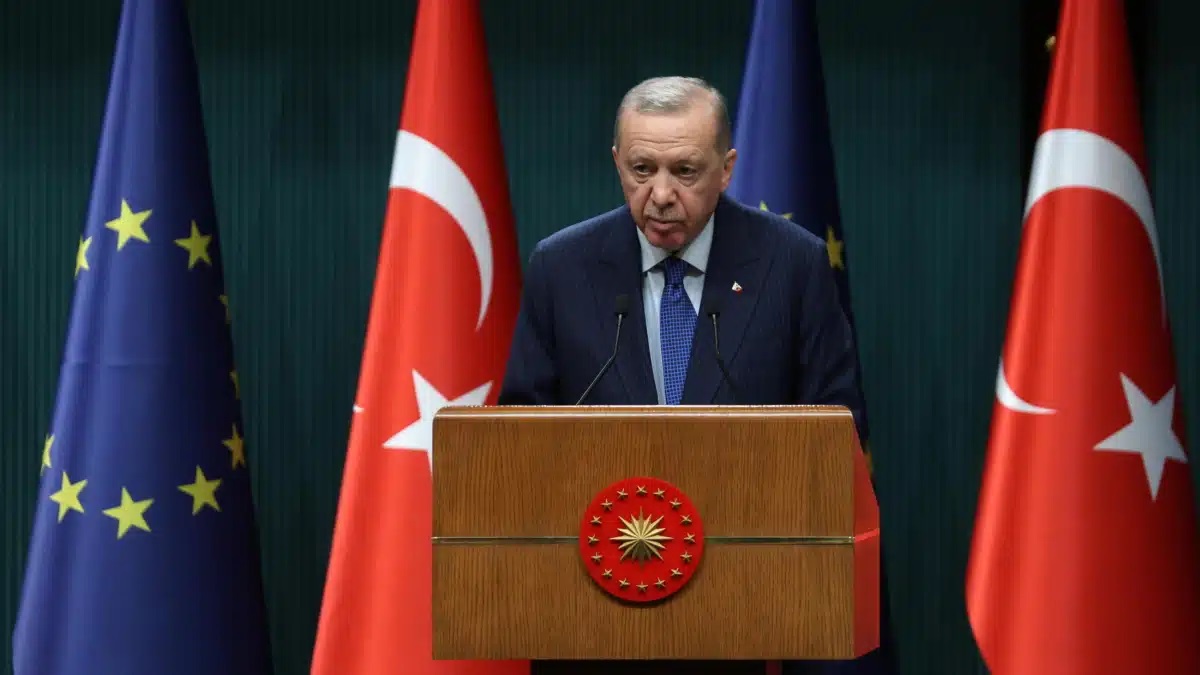
2025: el año de Turquía y Erdogan
Las empresas turcas exportan cada vez más a África, y cada vez hay más infraestructura renovada para dar cabida a estos nuevos productos
EDDC.NET / Adeje
Según el calendario chino, 2025 será el año de la serpiente de madera. Aunque realmente podemos afirmar que 2025 será el año de Turquía y del presidente Recep Tayyip Erdoğan. La caída de Damasco a manos de la oposición siria ha tenido como consecuencia que el peso regional de Turquía haya crecido a nivel regional, pero no solamente eso, sino que hay diferentes situaciones que permiten afirmar que 2025 será un año en el que habrá que mirar a Turquía por diferentes motivos. Desde su peso en los Balcanes, sus acuerdos con las monarquías del Golfo, hasta su papel en el norte de África. Incluso con España será clave la cooperación con Turquía, y en el desarrollo de la invasión rusa en Ucrania su intrínseco apoyo al presidente Volodimir Zelenski.
En primer lugar, será necesario poner la lupa en aquello que más nos afecta como europeos, y por eso debemos centrarnos en los Balcanes. A través de diferentes acuerdos de cooperación económica, cultural y militar, la república turca es uno de los principales actores en los Balcanes. Todos los países situados por debajo del Danubio, antigua frontera del Imperio Otomano durante siglos, tienen fuertes vínculos con Turquía, sobre todo la tríada musulmana, formada por Bosnia-Herzegovina, Kosovo y Albania. Después vendría su influencia clave en Montenegro, Bulgaria, Macedonia del Norte, Rumanía, y aunque parezca que no, también es fundamental para Hungría. Recordemos que Hungría forma parte de la Organización de los Estados Túrquicos.
La influencia turca en todos estos Estados tiene un efecto directo en la política exterior comunitaria. La UE es un actor preferente en las relaciones exteriores de todos estos países. Hay una normalización y buena vecindad desde hará un par de años con Grecia, y más después de la invasión rusa de Ucrania.
Este es otro aspecto importante, el papel de Turquía en apoyar a Ucrania ha sido fundamental para establecer su papel de mediador imparcial. Por un lado, siempre se ha mostrado crítico con las sanciones contra Rusia, pues hay importantes intercambios económicos entre Rusia y Turquía, aunque ahora veremos que sucede después del derribo del vuelo de AZAL, compañía nacional de Azerbaiyán, por parte de Rusia. Por otro lado, siempre Turquía se ha mostrado crítica y ha condenado la anexión rusa de Crimea y la vulneración de derechos de los tártaros, pueblo túrquico.
Turquía, junto con China, se está expandiendo económico por toda el área económica rusa, que debido a las sanciones se quedó vacía. Turkmenistán, Uzbekistán, Tadjikistán, Kirguizistán y Kazajstán se han alejado de Rusia y se han acercado a Turquía, más aún. Este hecho ha facilitado en gran medida que poco a poco la Unión Europea haya cerrado acuerdos energéticos y comerciales con todos ellos. Las sanciones a Rusia por parte de la Unión Europea han situado en todas estas repúblicas como socios económicos por su producción energética. En algunos casos han estado ayudando a Rusia a esquivar sanciones, y se han cobrado el favor haciendo negocio.
Después de los Balcanes y Europa, la caída de Damasco marca un punto de inflexión. No es casual que la primera misión en abrirse después de la entrada de las milicias islamistas haya sido la de Turquía. Desde el principio de las primaveras árabes, Qatar y Turquía iban con la oposición en Siria, y después de catorce años su apuesta se ha visto compensada. De Turkish Airlines, compañía estatal turca, serán los primeros vuelos internacionales que aterrizarán en Damasco y Alepo. Y serán ingenieros ferroviarios turcos los que reconstruirán la red ferroviaria siria.
Tal como se ha anunciado, hay interés y voluntad de querer reconstruir la historia línea otomana que comunicaba Estambul con Hejaz (Arabia Saudí), pero esta vez llegará hasta Damasco. Un apunte para los cinéfilos: esta línea es la que los árabes vuelan por los aires en Lawrence de Arabia.
La caída de Damasco, y el establecimiento de un gobierno interino sirio cuyos principales aliados son turcos y qataríes, también dibuja un escenario energético nuevo. Está sobre la mesa, tal como informó el ministro turco de Energía y Recursos Naturales, Alparslan Bayraktar, establecer la nueva conexión energética entre Turquía y Qatar, a través de Arabia Saudí y Siria. Esta nueva conexión quedó suspendida por las primaveras árabes. Así la UE reduciría la dependencia energética de Rusia y Estados Unidos.
Polonia fue uno de los países que primero potenció los vínculos entre Qatar y la Unión Europea. Para no depender de la energía rusa, desde la anexión de Crimea la compañía polaca Orlen trabaja con saudíes y qataríes. Esto sitúa de nuevo a Turquía en un papel central al hacer de puente entre el Golfo y la UE. Recordemos que también está sobre la mesa la conexión de mercancías India-UE, a través de Irak y Turquía, establecida como proyecto viable en la cumbre de Delhi del G20 en 2023.
Y, por último, el rol de Turquía en el Mediterráneo y África. Destaca su papel diplomático en Etiopía, Somalia y Eritrea, como también en Sudán. De esta manera aparece también Turquía allí, como contrapeso del creciente papel chino. Las empresas turcas exportan cada vez más a África, y cada vez hay más infraestructura renovada para dar cabida a estos nuevos productos.
Los líderes africanos no quieren fotos con Putin, ni quieren tener a Wagner en sus fronteras. Generan problemas, mala imagen exterior y son un foco problemático ahora que la popularidad está bajo mínimos. Frente a ello, aparece Turquía y Sadat (empresa militar privada turca), que presta su apoyo y formación para los gobiernos africanos. La neutralidad turca, y su nula intromisión en asuntos nacionales también es un punto a favor, incluso para ganar espacios en Marruecos y Argelia a la vez, o en apoyar a Trípoli mientras cierra acuerdos con Egipto, país que apoya a la facción contraria libia.
De este modo, la Turquía de Erdogan en 2025 ganará peso en los Balcanes, y por tanto dentro de la Unión Europea y la OTAN. También será mayor su relevancia en el Levante, alcanzando uno de los hitos de la política neootomana, de extender su influencia desde Damasco al Cáucaso Sur, y de Irak a Hungría. Y por medio la cuestión africana y mediterránea, donde es el único estado que puede tener una política marítima sin rival en el Mediterráneo oriental. Veremos qué sucede con la cuestión chipriota, ya que se espera que reconozcan Chipre del Norte.
English version
According to the Chinese calendar, 2025 will be the year of the wood snake. Although we can really say that 2025 will be the year of Türkiye and President Recep Tayyip Erdoğan. The fall of Damascus at the hands of the Syrian opposition has had the consequence that Turkey's regional weight has grown at the regional level, but not only that, but there are different situations that allow us to affirm that 2025 will be a year in which we will have to look to Turkey for different reasons. From its weight in the Balkans, its agreements with the Gulf monarchies, to its role in North Africa. Even with Spain, cooperation with Türkiye will be key, and in the development of the Russian invasion of Ukraine its intrinsic support for President Volodymir Zelensky.
First of all, it will be necessary to put the magnifying glass on what affects us most as Europeans, and that is why we must focus on the Balkans. Through different economic, cultural and military cooperation agreements, the Turkish Republic is one of the main actors in the Balkans. All countries located below the Danube, the former border of the Ottoman Empire for centuries, have strong ties with Turkey, especially the Muslim triad, formed by Bosnia-Herzegovina, Kosovo and Albania. Later would come its key influence in Montenegro, Bulgaria, North Macedonia, Romania, and although it may not seem like it, it is also fundamental for Hungary. Let us remember that Hungary is part of the Organization of Turkic States.
Turkish influence in all these States has a direct effect on Community foreign policy. The EU is a preferred actor in the foreign relations of all these countries. There has been normalization and good neighborliness for a couple of years with Greece, and even more so after the Russian invasion of Ukraine.
This is another important aspect, Türkiye's role in supporting Ukraine has been instrumental in establishing its role as an impartial mediator. On the one hand, he has always been critical of the sanctions against Russia, since there are important economic exchanges between Russia and Turkey, although now we will see what happens after the downing of the AZAL flight, Azerbaijan's national company, by Russia. On the other hand, Türkiye has always been critical and has condemned the Russian annexation of Crimea and the violation of the rights of the Tatars, a Turkic people.
Türkiye, together with China, is expanding economically throughout the Russian economic area, which due to sanctions was left empty. Turkmenistan, Uzbekistan, Tajikistan, Kyrgyzstan and Kazakhstan have moved away from Russia and closer to Türkiye, even more so. This fact has greatly facilitated the fact that little by little the European Union has closed energy and trade agreements with all of them. The sanctions against Russia by the European Union have placed all of these republics as economic partners for their energy production. In some cases they have been helping Russia avoid sanctions, and they have cashed in by doing business.
After the Balkans and Europe, the fall of Damascus marks a turning point. It is no coincidence that the first mission to open after the entry of the Islamist militias was that of Türkiye. Since the beginning of the Arab springs, Qatar and Türkiye went with the opposition in Syria, and after fourteen years their bet has been compensated. From Turkish Airlines, a Turkish state company, these will be the first international flights to land in Damascus and Aleppo. And it will be Turkish railway engineers who will rebuild the Syrian railway network.
As has been announced, there is interest and willingness to reconstruct the historical Ottoman line that connected Istanbul with Hejaz (Saudi Arabia), but this time it will reach Damascus. A note for movie buffs: this line is the one the Arabs blow up in Lawrence of Arabia.
The fall of Damascus, and the establishment of an interim Syrian government whose main allies are Turks and Qataris, also paints a new energy scenario. It is on the table, as reported by the Turkish Minister of Energy and Natural Resources, Alparslan Bayraktar, to establish the new energy connection between Turkey and Qatar, through Saudi Arabia and Syria. This new connection was suspended due to the Arab Spring. Thus the EU would reduce energy dependence on Russia and the United States.
Poland was one of the countries that first strengthened ties between Qatar and the European Union. In order not to depend on Russian energy, since the annexation of Crimea, the Polish company Orlen has been working with the Saudis and Qataris. This once again places Turkey in a central role in acting as a bridge between the Gulf and the EU. Let us remember that the India-EU goods connection, through Iraq and Türkiye, established as a viable project at the G20 Delhi summit in 2023, is also on the table.
And finally, Türkiye's role in the Mediterranean and Africa. His diplomatic role stands out in Ethiopia, Somalia and Eritrea, as well as in Sudan. In this way Türkiye also appears there, as a counterweight to the growing Chinese role. Turkish companies are increasingly exporting to Africa, and more and more infrastructure is being renovated to accommodate these new products.
African leaders do not want photos with Putin, nor do they want to have Wagner on their borders. They generate problems, a bad external image and are a problematic focus now that popularity is at a minimum. Faced with this, Türkiye and Sadat appear (a Turkish private military company), which provides support and training for African governments. Turkish neutrality, and its lack of interference in national affairs, is also a point in its favor, even to gain space in Morocco and Algeria at the same time, or to support Tripoli while closing agreements with Egypt, a country that supports the opposing Libyan faction.
In this way, Erdogan's Turkey in 2025 will gain weight in the Balkans, and therefore within the European Union and NATO. Its relevance in the Levant will also be greater, reaching one of the milestones of neo-Ottoman policy, extending its influence from Damascus to the South Caucasus, and from Iraq to Hungary. And in between the African and Mediterranean issue, where it is the only state that can have a maritime policy without rival in the eastern Mediterranean. We will see what happens with the Cypriot issue, since they are expected to recognize Northern Cyprus.
